Events
Who says you can't talk in the library? Just as you gather in Butler or Burke Library with friends and acquaintances to talk about books, debate ideas, work on your research, and even just hang out, so too did bookish people of the past.
The library has always been a meeting place for people from distinct religious communities. They often spoke different languages, and they generally disagreed about many things. But they engaged in dialogue. How, exactly? And why?
Come join IRCPL Director Seth Kimmel and Burke Library's Collection Services Librarian Jeffrey Wayno to explore some rare books and manuscripts that tell the stories of these encounters, and stay for the free lunch!
At moments of political and social crisis, conversation offers the possibility of compromise, if not also reconciliation and understanding. When religious histories and tensions run through these crises—as they so often do—many of us might think of turning to that particular subset of conversation known as “interfaith dialogue.” How do advocates and practitioners of interfaith dialogue understand and promote its protocols? How do they chart its origins and aims? How do they imagine the local scale of interfaith dialogue, which necessarily takes place among a specific subset of individuals located in a particular place and time, and its larger geopolitical and theological stakes? How does interfaith dialogue relate to pluralism and multiculturalism? Following concise presentations, our speakers will reflect on these questions while entering into conversation with each other and with the audience.
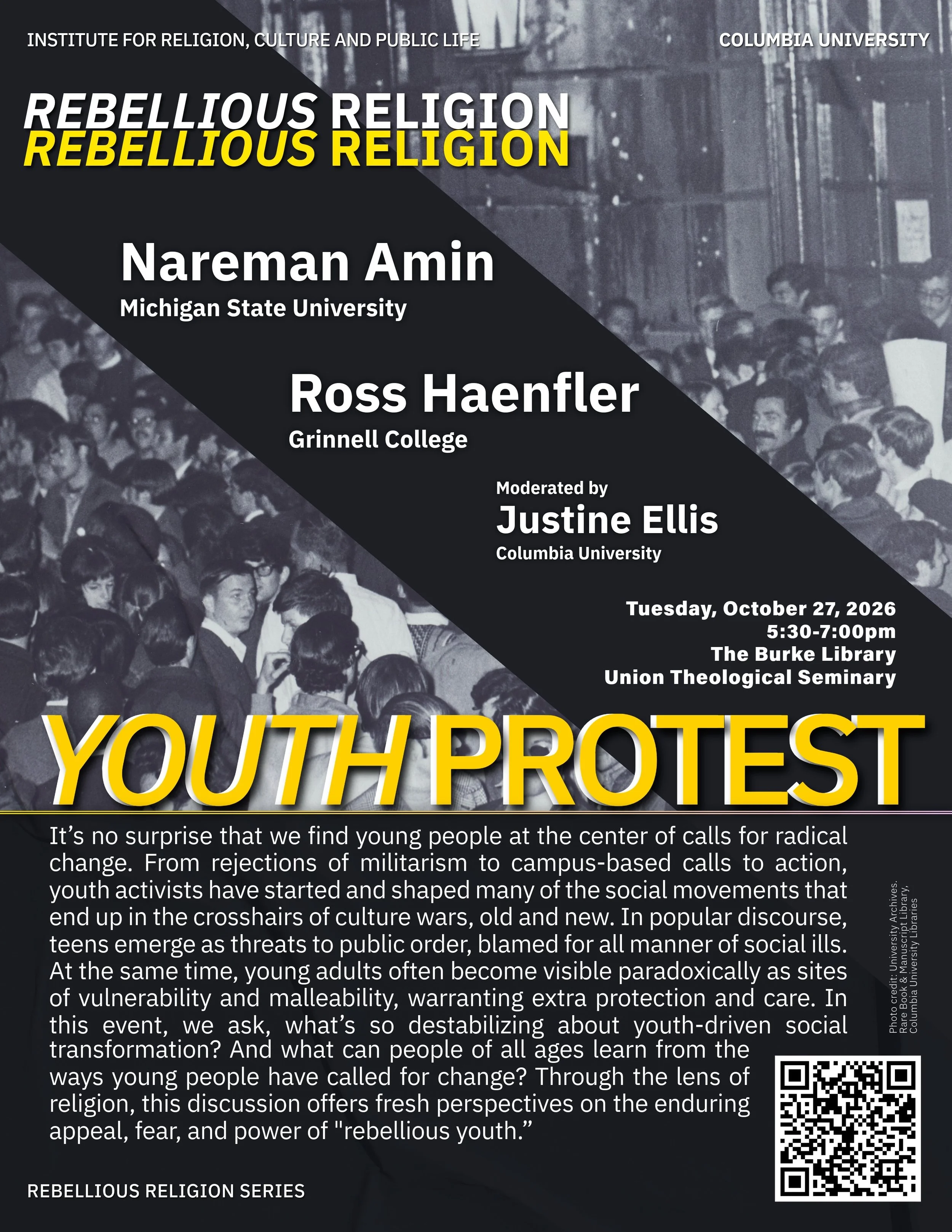
It’s no surprise that we find young people at the center of calls for radical change. From rejections of militarism to campus-based calls to action, youth activists have started and shaped many of the social movements that end up in the crosshairs of culture wars, old and new. In popular discourse, teens emerge as threats to public order, blamed for all manner of social ills. At the same time, young adults often become visible paradoxically as sites of vulnerability and malleability, warranting extra protection and care. In this event, we ask, what’s so destabilizing about youth-driven social transformation? And what can people of all ages learn from the ways young people have called for change? Through the lens of religion, this discussion offers fresh perspectives on the enduring appeal, fear, and power of "rebellious youth.”